sdf · csg · lisp · 3d modeling
BurinBeta
Design 3D parts for 3D printers via code, an LLM (like Claude or OpenAI) or via API scripting. Bruin is a Lisp scripted SDF / CSG solid modeler with a raymarched preview and binary STL export.
Features
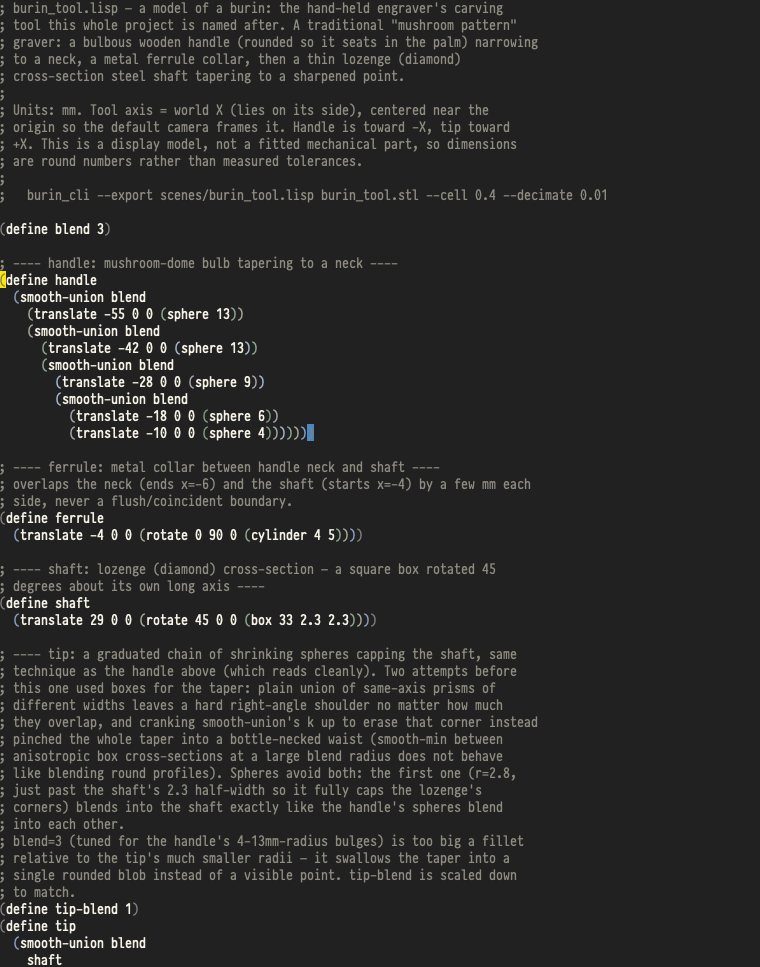
Define 3D geometry with a complete domain specific language. SDF primitives, CSG operations, transforms all composable in a clean, evaluable syntax.
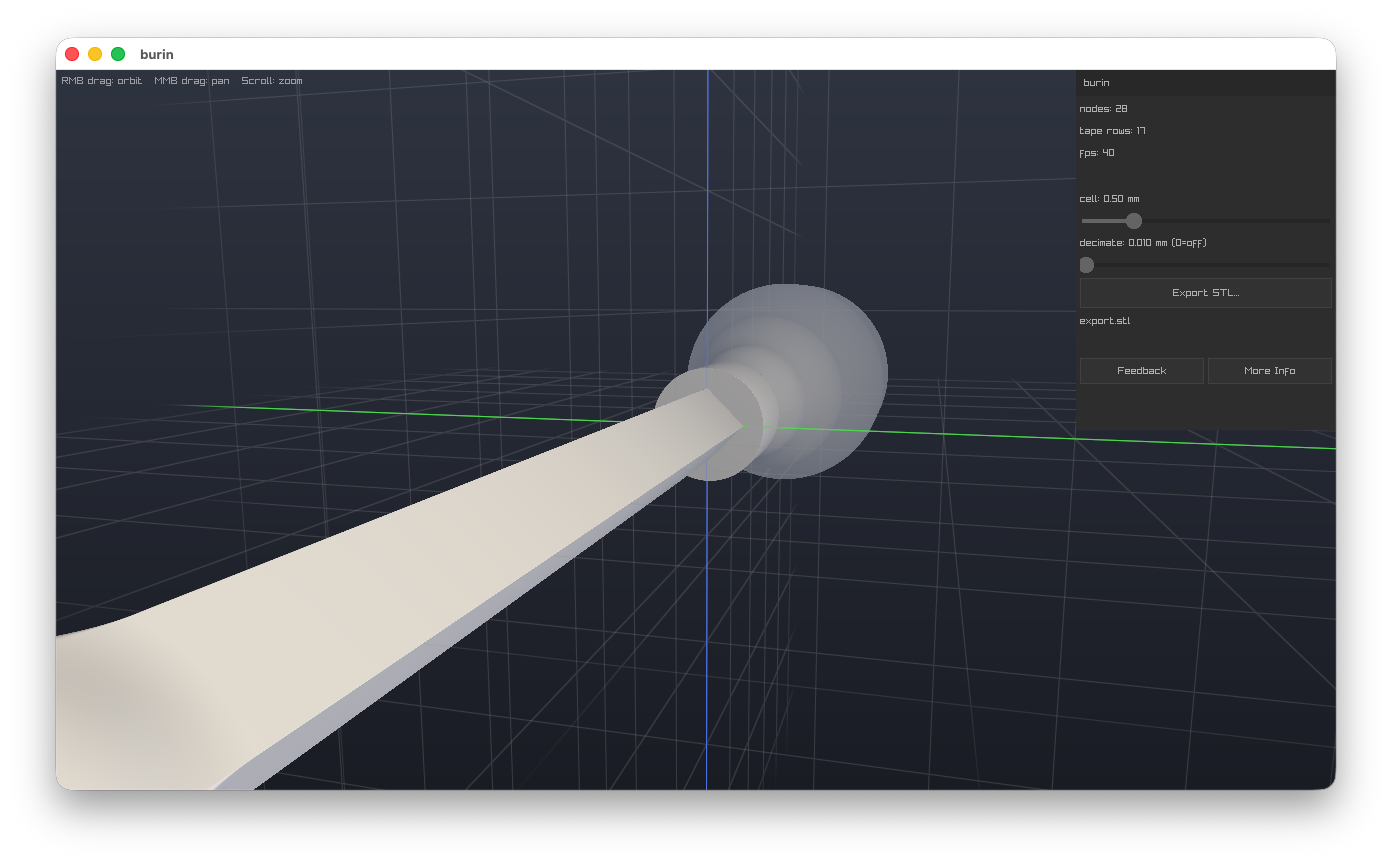
Real time, GPU accelerated, fragment shader using raymarching with orbit / pan / zoom controls. The preview updates instantly as scripts are pushed via HTTP.
Correctly wound manifold STL output via marching cubes + quadric edge collapse decimation. Slicer ready with no repair step needed.
Built-in server exposes `POST /eval` and `POST /export` endpoints. Evaluate Lisp source and export STL files programmatically.
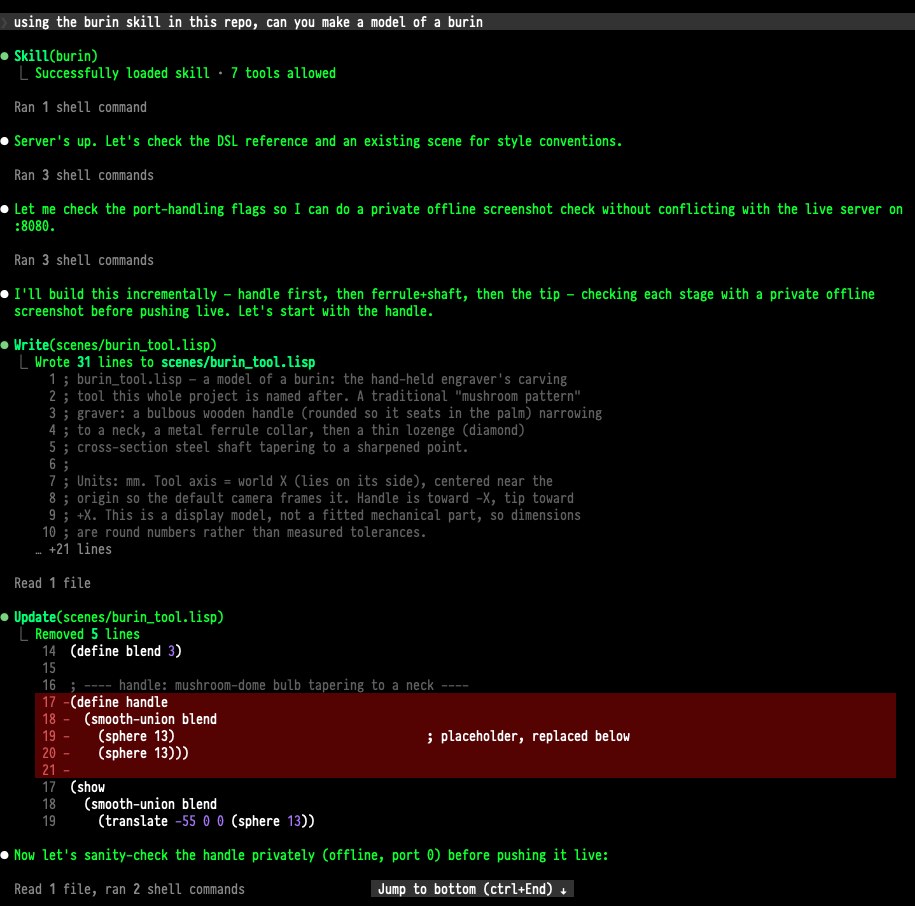
Built for programmatic, API driven iteration. An LLM can design, modify, and export parts entirely through HTTP calls.
FAQ
- What is Burin?
- Burin is a Lisp based SDF/CSG solid modeler with a live raymarched preview window, binary STL export, and a local HTTP API. It is designed for headless, API-driven 3D modeling workflows, with LLM agents in mind.
- How does Burin work?
- You define 3D geometry using a Lisp DSL with SDF primitives (sphere, box, cylinder, capsule, torus) combined with CSG operations (union, intersection, difference, smooth union / difference / intersection) and transforms. The scene renders in real time via GPU raymarching, and exports to STL.
- Can Burin run without a GUI?
- Yes. Burin has a headless CLI and a local HTTP API. You can evaluate Lisp scripts and export STL files entirely via POST requests without using the GUI. This makes it ideal for LLM agents and automation.
- What is the export quality?
- Burin exports "watertight", correctly wound manifold STL files via marching cubes with configurable quadric edge collapse decimation. Outputs are slicer ready with no repair step needed. The default cell size is 0.5mm, and decimation can reduce triangle counts 80–400x while preserving print quality accuracy.
- What units does Burin use?
- Burin uses a hard unit convention: 1.0 float unit = 1.0 mm everywhere. The coordinate system is Z up, matching most CAD and slicer conventions.
- Is Burin finished?
- Burin is currently in beta. Core functionality including the modeling DSL, raymarched preview, STL export, and HTTP API are working. The product is actively being developed.